


The June 2026 release of SBTi's Corporate Net-Zero Standard V2.0 is the most significant overhaul in a decade, rewriting the rulebook for how energy attribute certificates (EACs), sustainable aviation fuel (SAF) certificates, and other climate performance assets (‘commodity certificates’ per SBTi) count toward corporate targets.
For EAC and SAFc buyers, this is not a peripheral update - it directly determines which instruments remain eligible, what documentation procurement teams must now produce, and how much technical scrutiny each purchase requires going forward. This article breaks down what changed, what it means at each stage of the buying process, and how to prepare before the standard becomes effective in February 2027.
Key takeaways
- From target-setting to action framework: SBTi V2.0 transitions the standard from target-setting to an explicit "action framework," shifting the buyer's burden from broad commitments to granular, transparent demonstration of decarbonization efforts.
- Implementation hierarchy priorities: The new three-tier hierarchy clarifies where climate performance assets fit, allowing buyers to simplify compliance by focusing on activity-level matching and reducing the need to justify structural constraints.
- Stricter Scope 2 compliance: With new deliverability region matching, a 15-year generator age cap, and hourly matching disclosure requirements, buyers must rigorously audit their existing electricity procurement portfolios to ensure continued eligibility.
- Validation of Scope 1 and 3 instruments: Climate performance assets (including SAFc) are now formally recognized under strict quality guardrails, providing buyers with new, compliant tools for hard-to-abate sectors, provided they meet verifiable assurance standards.
- Navigating future reporting frameworks: Upcoming GHG Protocol revisions and the newly proposed ISO 14060 standard go in the same direction, formalizing how climate performance assets will be used in GHG accounting and reporting.
1. The big shift: from target-setting to an action framework
When SBTi released Version 1.0 of its Corporate Net-Zero Standard in 2021, the primary question it raised was: what targets should companies set? Version 2.0, finalized in June 2026, asks a fundamentally harder question: how should companies actually deliver them?
The finalized Standard is explicitly framed as an "action framework" built on a best-efforts principle: companies are expected to deploy every lever within their control, be transparent about structural barriers, and demonstrate ongoing action to overcome them. This is a meaningful softening of the pass/fail mentality, but includes extensive and granular rules about what counts, where, and when.
For companies considering climate performance assets for their decarbonization journey, the most consequential changes are in Chapter 4: Target Implementation. This chapter introduces the implementation hierarchy, the quality criteria for all climate performance assets (including EACs, SAFc, and other commodity certificates), and the detailed rules for Scope 2 electricity matching. Together, these rules define which certificates count towards net zero, and under which conditions.
Effective date: The Corporate Net-Zero Standard V2.0 is approved as of June 11, 2026, and becomes effective from February 1, 2027. Companies with existing validated targets will transition to V2.0 requirements at their next target cycle assessment.
What this means for buyers: Treat this as a compliance runway, not a future concern - target submissions and procurement documentation built today should already reflect V2.0's evidentiary standard, since existing targets transition at the next assessment cycle regardless of submission date.
2. The implementation hierarchy: where climate performance assets fit
The foundational structure governing the use of all market instruments, including EACs, SAFc, and other climate performance assets, is a three-tier implementation hierarchy (CNZS-C21) reflecting a prioritized escalation path.
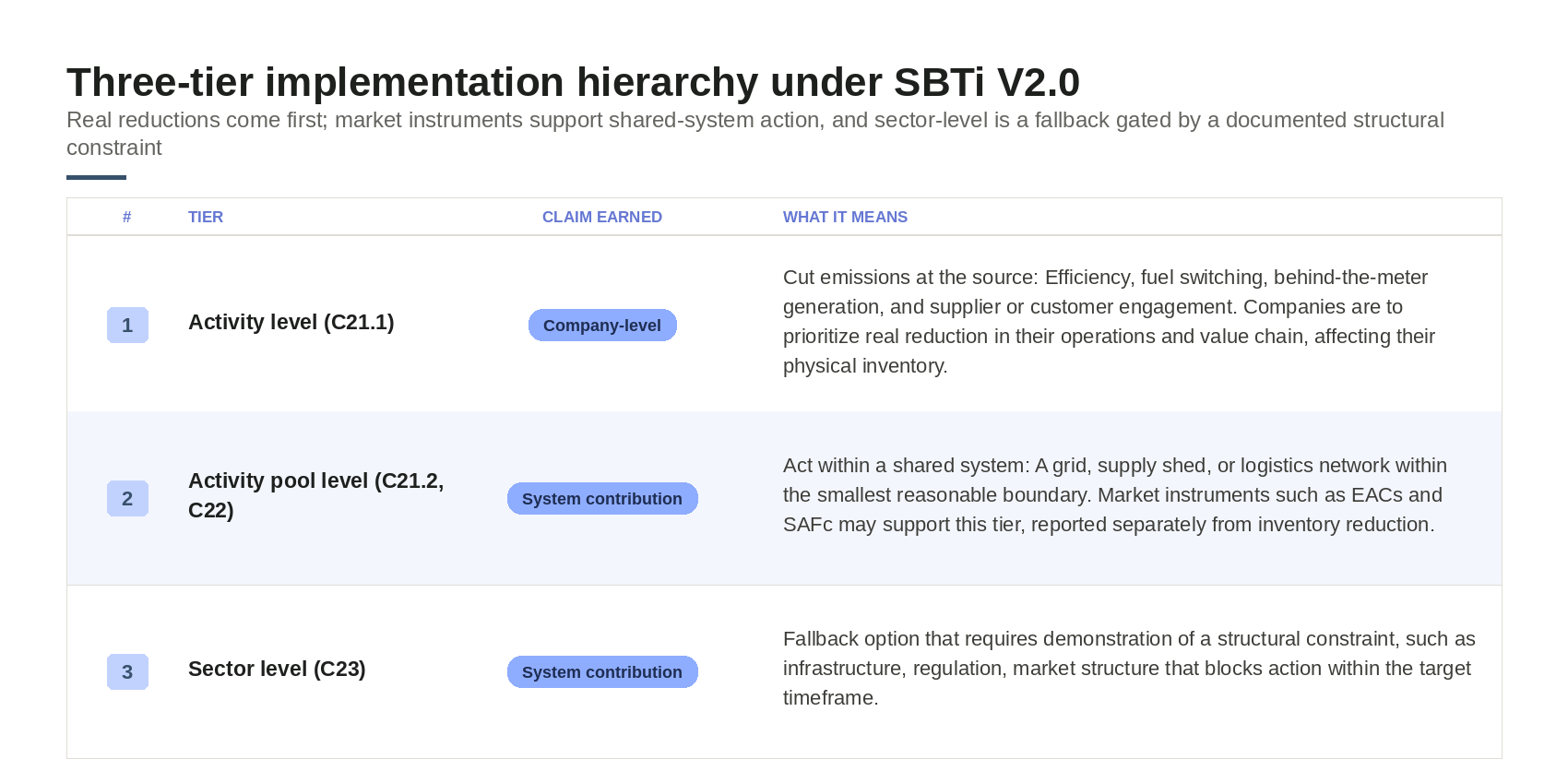
Level 1 includes direct emission reductions executed at the source, counting directly toward the company's physical inventory. The critical implication of the hierarchy is that EACs, SAFc, and other certificates purchased at the activity-pool level (Level 2) are fully valid without needing to prove structural constraints. Only when certificates are used to claim sector-level progress (Level 3) must companies formally document why they cannot act within their own deliverability region or supply chain. This pragmatic, important clarification ideally reduces over-lawyering around market instrument eligibility for most standard Scope 2 electricity purchases.
What this means for buyers: Wherever possible, structure purchases to land at Level 2 as this clears the eligibility bar without the added burden of justifying structural constraints that Level 3 sector-level claims now require.
3. Energy Attribute Certificates (EACs): the Scope 2 rules
Eligible market instruments for Scope 2 (CNZS-C31)
The Standard defines an Energy Attribute Certificate (EAC) as ‘a market instrument that conveys information (attributes) about a unit of energy, including the resource used to create the energy and the emissions associated with its production and use.’ This definition explicitly encompasses Renewable Energy Certificates (RECs) in North America, Guarantees of Origin (GOs) in Europe, International Renewable Energy Certificates (I-RECs) for international markets, and equivalent national certificate schemes.
For electricity consumed from an activity pool (i.e., the grid), the Standard defines a ranked list of eligible instruments:
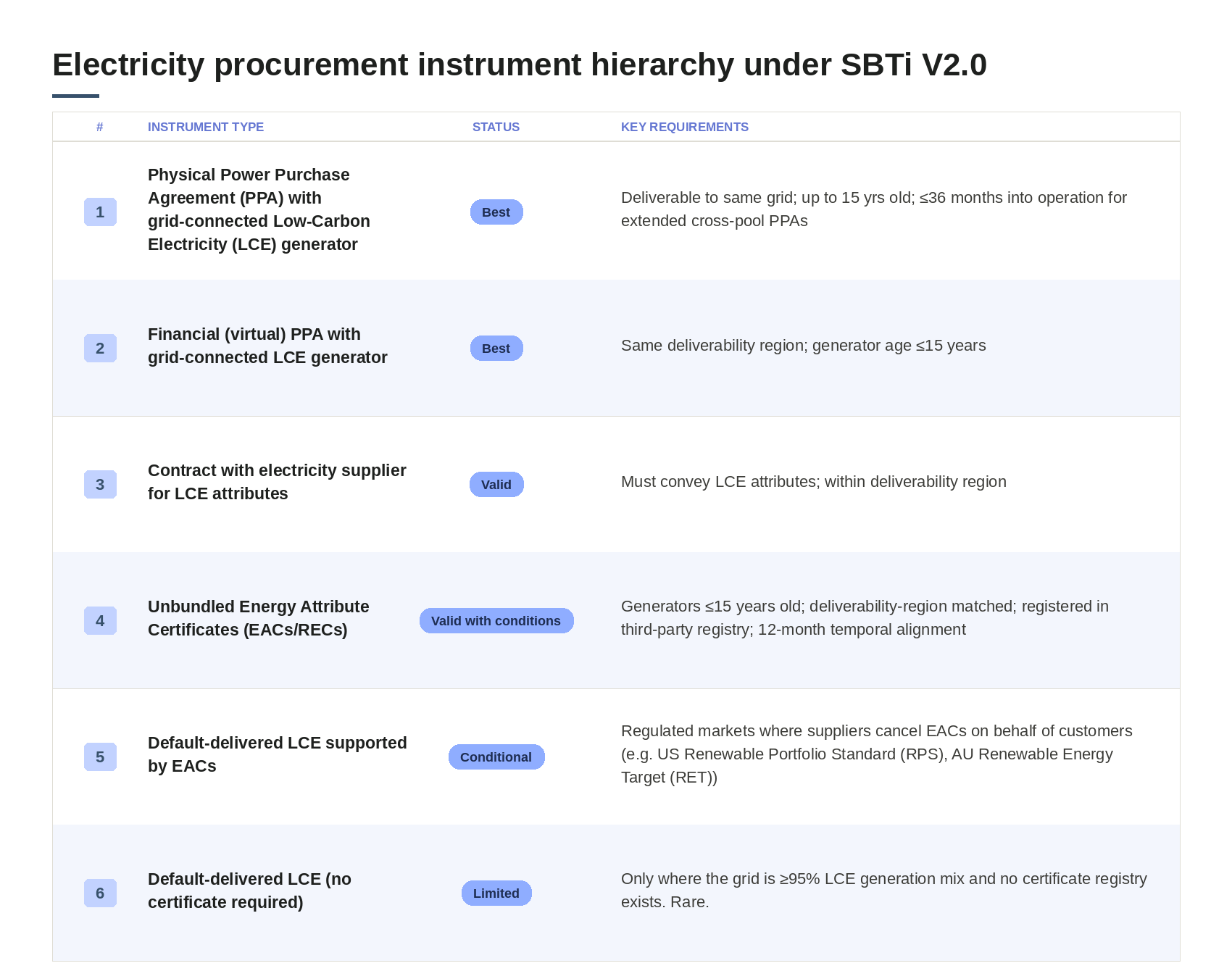
Quality conditions for EACs
One of the most commercially significant quality rules is the 15-year generator age cap: EACs and PPAs may only be applied to electricity consumption if the underlying generator was commissioned or last re-powered within 15 years of the consumption period. This aligns with RE100's technical criteria and reflects the principle that certificates should support new renewable energy projects.
Additionally, the new guidance introduces an explicit requirement for geographic matching based on deliverability regions. Companies must purchase EACs or PPAs from generators that are physically capable of delivering power to the grid serving their consumption. This replaces the looser country-level matching that was common under the previous version.
There are two pathways to cross-pool deliverability:
- Where the company can demonstrate physical transmission and holds necessary transmission rights recognized by transmission system operators; or
- Where operations span two or more interconnected activity pools in a wide-area synchronous grid, and the PPA is for a project commissioned within 36 months — aggregate load can then be covered by a single PPA from any pool in the grid.
A legacy clause (CNZS-C30.5) protects existing long-term contracts: instruments from contracts signed before V2.0's effective date (February 1, 2027) may continue to be applied to the same activity pools as before. Renewals do not extend this protection.
Hourly matching: disclosure now, compliance later
Annual matching of EACs to electricity consumption has been the de facto standard under previous SBTi rules and GHG Protocol Scope 2 guidance. V2.0 introduces a transitional framework that recognizes the necessary shift towards hourly matching without yet making it mandatory for target compliance.
The specific obligations under CNZS-C32 are:
- Significance threshold: Only significant pools (annual consumption is 10 GWh or more per grid) require hourly calculation.
- Hourly matching calculation: Companies must calculate, and then report publicly, the percentage of LCE used, contracted, or matched on an hourly basis against significant electricity consumption.
- Category A company assurance: The hourly matching percentage must be independently assured as part of Category A company target progress assurance.
- No mixing of intervals: Companies cannot combine annual and hourly matching within the same activity pool (temporal accounting consistency).
An optional Scope 2 hourly matching recognition program (CNZS-C33) will publicly distinguish companies that achieve specified hourly matching thresholds, creating a market signal and a competitive differentiator for buyers demonstrating hour-by-hour clean power alignment.
What this means for buyers: If your EACs come from a different synchronous grid zone than your facilities, they will not count under V2.0 unless deliverability can be demonstrated. Unbundled EACs from non-interconnected regions are now treated as sector-level actions requiring documented structural constraints, a major shift from prior practice in many US, Canadian, Asian, and emerging markets.
4. Market instruments for Scope 1 and Scope 3
Beyond electricity, V2.0 explicitly recognizes a broader class of climate performance assets for use in implementing Scope 1 and Scope 3 targets related to fuels, feedstocks, materials, and logistics. The Standard's definition is deliberately broad: ‘a third-party-assured market instrument that represents the environmental attributes of an underlying good, product, or service.’
While SBTi V2.0 does not specify which, commodity certificates directly encompasses:
- SAF certificates (SAFc): Book-and-claim instruments representing the GHG attributes of SAF production, used by airlines and corporate travel buyers without physical SAF delivery
- Renewable Natural Gas (RNG) / Biomethane certificates: Certificates under book-and-claim schemes for grid-injected biogas
- Green hydrogen attribute certificates: Representing low-carbon hydrogen production
- Sustainable materials certificates: For steel, cement, aluminum, and chemicals with certified lower-carbon production pathways
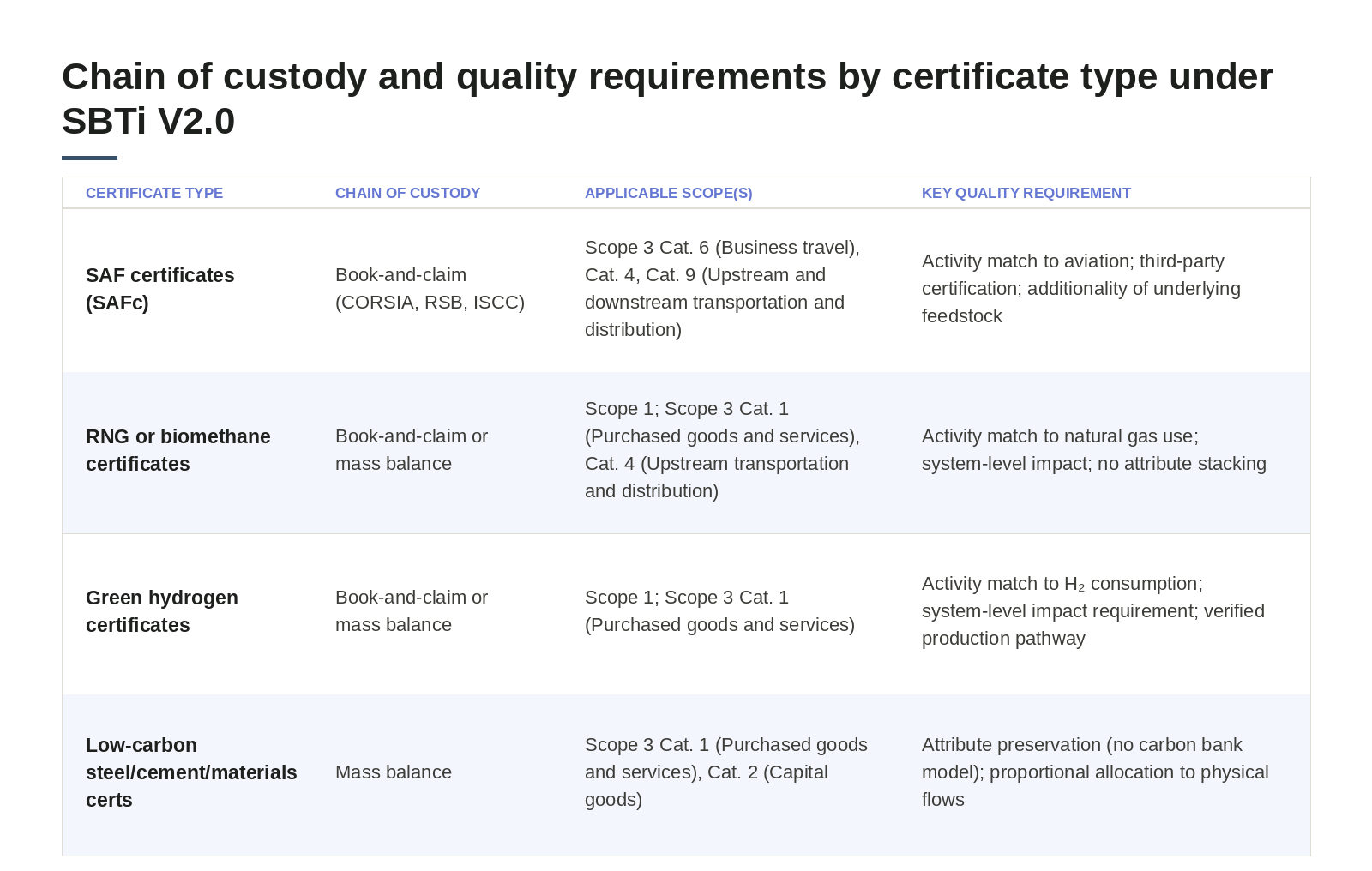
The Standard affirms that market instruments relying on mass balance or book-and-claim chain-of-custody models are permitted, "subject to guardrails." All actions and market instruments — EACs, RECs, SAFc, biomethane certificates, or other climate performance assets — must meet seven core quality criteria set out in CNZS-C25, applying regardless of hierarchy level:
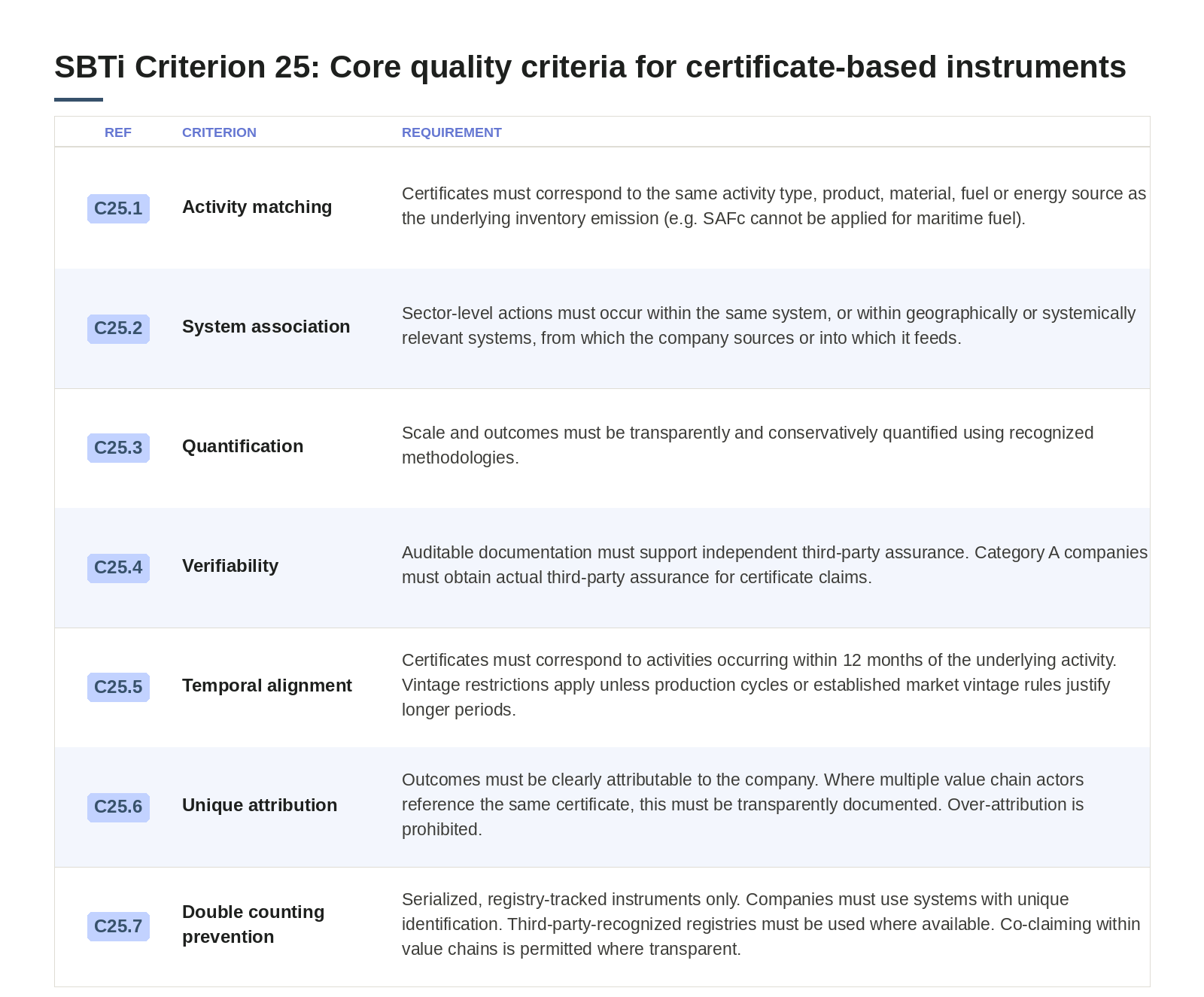
Beyond the seven universal criteria, market instruments face four additional tests:
- Representative instruments (C27.1): The instrument must accurately and conservatively convey the emissions or physical attributes of the underlying activity. There can be no greenwashing through inflated emission factors.
- Volume matching (C27.2): Volume of certificates cannot exceed the volume of the corresponding activity in the GHG inventory. You cannot buy more SAF certificates than your actual aviation fuel consumption.
- No Carbon Banks (C27.4): Emissions attributes must be allocated proportionally to physical flows across processing stages. They cannot be concentrated or redistributed non-proportionally to a subset of products. This effectively prohibits disproportional claims against premium product lines.
- System-level impact (C27.5): Where instruments are issued through programs or frameworks (e.g., a book-and-claim scheme), those programs must demonstrate that corporate demand for the certificates actually contributes to increased supply of the low-carbon commodity. This is a forward-looking market integrity test.
CNZS-C28 further requires that all EACs and commodity certificates must be issued, transferred, and retired through transparent, secure tracking systems that prevent double-counting. This means:
- Certificate issuance, transfer, redemption, cancellation, and retirement must be recorded in a secure registry or equivalent system of records.
- For Category A companies, conformance with all use, eligibility, and transaction requirements must be independently assured as part of the third-party assurance of target progress data.
What this means for buyers: The formal recognition of SAFc and similar instruments is a genuine procurement unlock for hard-to-abate Scope 1 and 3 activities — but it raises the bar, not lowers it. Every asset now needs to be vetted against all seven C25 criteria plus the four instrument-specific tests, with particular attention to third-party assurance and volume matching. Treat these as structural integration tools, not offsets, and build audit-ready documentation into procurement from day one.
Looking ahead and how CEEZER can help
The SBTi Corporate Net-Zero Standard V2.0 is a significant step in allowing climate performance asset markets to serve as legitimate decarbonization tools, but with conditions that reward quality procurement and penalize greenwashing. The underlying GHG accounting framework, the GHG Protocol (GHGP), is still under revision, and SBTi V2.0 explicitly notes that updates will be considered once that process concludes.
Two active GHG Protocol workstreams will raise the bar further: the Scope 2 revision proposes making hourly matching and deliverability region sourcing mandatory (not just best practice) for any market-based Scope 2 claim, targeted for finalization in late 2027; and the Actions and Market Instruments (AMI) standard aims to require SAFc, biomethane book-and-claim, and green hydrogen certificates to be disclosed separately from physical GHG inventory totals. Both tracks are expected to move in parallel, likely between 2027 and 2030.
Additionally, the ISO/DIS 14060 international net-zero standard (published June 2026) introduces a four-stage net-zero claims framework, establishing that climate performance assets (ISO calls them Environmental Commodity Certificates), such as EACs, SAFc, must be reported separately from carbon neutralization claims, which at net zero must rely solely on carbon dioxide removals.
For buyers managing a portfolio of climate performance assets, SBTi V2.0 and ISO 14060 will increasingly need to be navigated in parallel. The most important implications for buyers procuring SAFc and EACs under SBTi V2.0:
- Prioritize transparency: Pivot reporting strategy to emphasize detailed documentation of structural barriers rather than just broad target-setting.
- Use the hierarchy to simplify compliance: Leverage the three-tier implementation hierarchy to streamline Scope 1-3 strategy and focus efforts that align with operational activities.
- Refine EAC eligibility: Ensure all EAC and PPA procurement meets the new 15-year generator age cap, 12-month vintage alignment, and strict deliverability region matching requirements to maintain V2.0 compliance.
- Prepare for temporal and hourly disclosure: For Category A companies with consumption of more than 10GWh per grid, initiate hourly matching data collection to prepare for upcoming reporting mandates.
- Adopt a due-diligence mindset: Treat Scope 1 and 3 commodity certificates (like SAFc and biomethane certificates) with the same technical scrutiny as high-quality carbon credits, ensuring every asset meets the C25 quality guardrails.
For enterprises navigating these markets under SBTi V2.0, CEEZER provides expert, end-to-end support: from identifying the right certificates against the SBTi standard's quality criteria and ISO 14060 reporting requirements, to procurement documentation that directly supports corporate reporting, credible claims, and audit readiness.
CEEZER's platform aggregates high-quality EACs and SAFc from multiple producers and registries and applies due diligence and quality assessment to every listed certificate — covering generator age, deliverability region, temporal alignment, certification scheme, and registry status. It also collects and stores assurance relevant data, which is ready for export when needed.
Its data infrastructure enables real-time portfolio management across EACs, SAFc, and carbon credits in one place, removing the information asymmetries that currently limit corporate participation, ensuring seamless assurance process for buyers across climate asset markets.
If you'd like to discuss your climate performance asset portfolio or strategy in light of SBTi V2.0 with an expert from our team - please reach out here.
Further readings from CEEZER
- SBTi Corporate Net-Zero Standard V2.0 is out. Here's what carbon credit buyers need to know: CEEZER’s in-depth analysis on SBTi V2.0’s guidance on carbon credits, including carbon removal and beyond value chain mitigation (BVCM)
- ISO/DIS 14060 — What the international net-zero standard means for corporate carbon buyers: Key takeaways from the new draft International Standard for ISO/DIS 14060 "Net Zero Aligned Organizations", including guidance for using carbon credits and other environmental commodity certificates (ECCs).







.png)