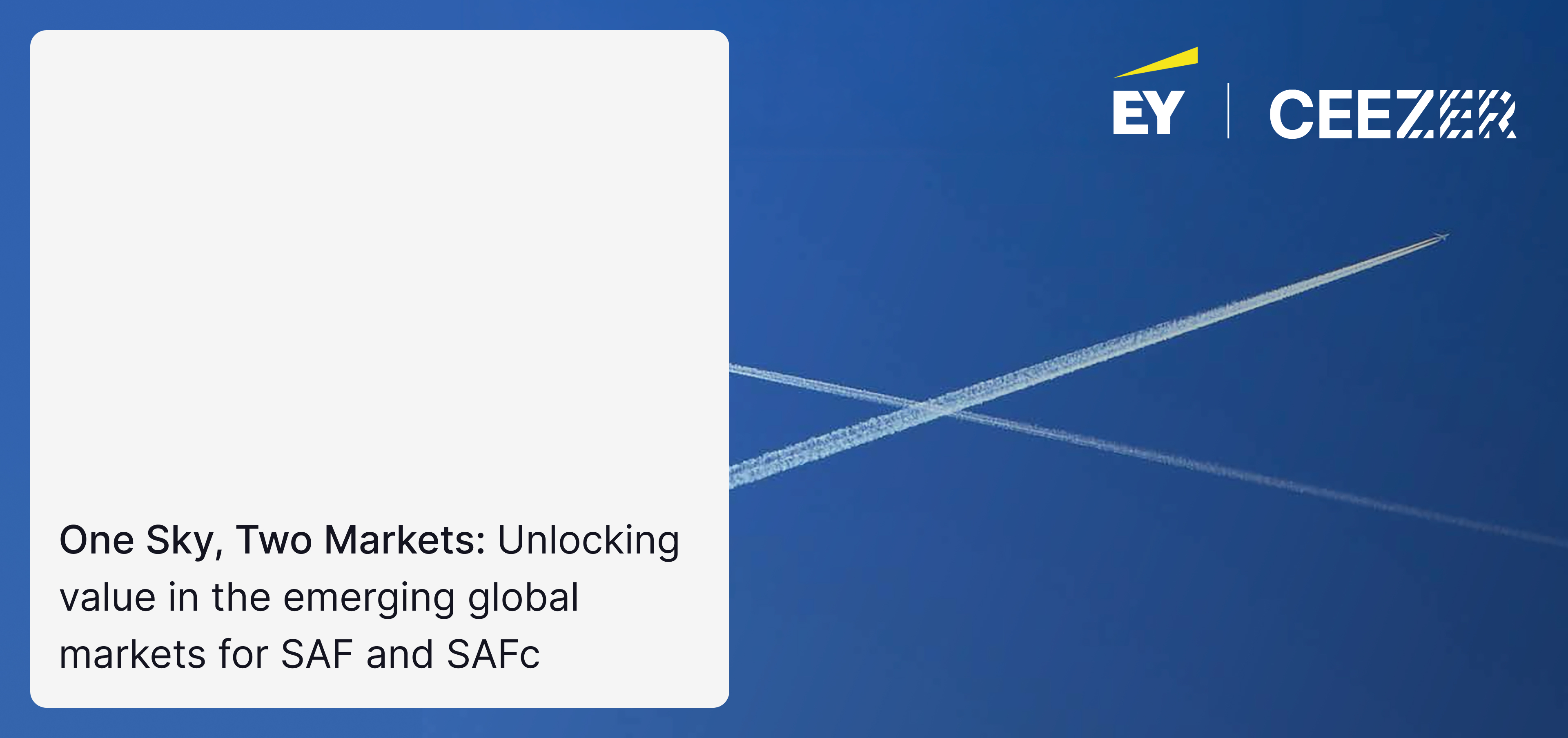



EY and CEEZER collaborated on their latest joint white paper, ‘One Sky, Two Markets: Unlocking value in the emerging global markets for SAF and SAFc.’
Sustainable Aviation Fuel (SAF) is the only viable defossilization pathway for air travel - it is also structurally short of where it needs to be. On announced projects, SAF supply covers barely half of regulation-driven demand by 2050 - and the shortfall concentrates exactly where mandates are strictest: in Europe. SAF supply needs to scale significantly for airlines and corporate buyers to meet their net zero targets.
SAF certificates (SAFc) help address the part of the problem physical fuel can't: cost. Book-and-claim unbundles the environmental attribute from the fuel itself, letting one certified batch back both a Scope 1 certificate for the airline and a linked Scope 3 certificate for a corporate buyer. That splits the SAF premium across the value chain and gives corporates an in-sector tool to address Scope 3 emissions that didn't exist before.
The SAFc market is scaling fast, but it is still emerging. SAFc retirements grew from 740 tCO2e in 2022 to roughly 1 MtCO2e in 2025, and SBTi's Net-Zero Standard V2.0 now recognizes SAFc as an eligible commodity certificate, giving more certainty to corporate buyers. However, recognition for target-setting hasn't yet translated into compliance accounting. As long as book-and-claim sits outside the GHG Protocol and mandate frameworks, demand stays voluntary and detached from the volumes that actually finance production.
Why buyers should act before the market matures:
- The price floor is moving. Scope 3 certificates trade at ~$200–650/tCO2e. As supply shifts toward costlier pathways like e-SAF, and feedstock prices for biofuels are expected to increase, that floor only moves up. Buying now secures more favourable prices.
- Offtake finances the pipeline. Producers need revenue certainty to reach a final investment decision. Early commitments are the demand signal that gets production financed and built.
- The buyer pool won't stay this open. SBTi's Net-Zero Standard V2.0 just made SAFc eligible for target-setting; thus, new demand is coming for the same limited certificate pool.
Get the full picture by downloading EY and CEEZER’s latest white paper below.
Download here.
The SAFc market is still emerging, and corporates benefit from expert guidance on purchasing and reporting. CEEZER supports companies on their net‑zero journey by defining climate asset strategies and enabling efficient SAFc sourcing at attractive prices with independent quality checks. Schedule a call with our climate asset experts to learn more.







.png)