
On 17 July 2026, the European Commission proposed folding carbon removal into Europe's compliance carbon market for the first time. It is not a simple opening of the ETS to voluntary credits. The mechanics are new, and they will determine who benefits and when.
This guide translates the proposal into easy language for carbon buyers so you can understand: what's actually on the table, what's likely to happen next, and what buyers can do today while it's still being negotiated in Brussels.
The CRCF backdrop
Carbon removal did not start with this ETS proposal; it already sits inside a certification system the EU has been building since late 2024.
Where CRCF stands today
The Carbon Removals and Carbon Farming Regulation (CRCF) entered into force in December, 2024. It established the EU’s first voluntary certification framework for three types of activity: permanent removals (DACCS, BioCCS, biochar), carbon farming (soil carbon, agroforestry, peatland rewetting, afforestation), and long-term carbon storage in products. All projects will be assessed against the same QU.A.L.ITY criteria: quantification, additionality, long-term storage, and sustainability.
Access CEEZER’s in-depth Buyer’s Guide on CRCF.
The framework has moved to a fully operational system over the past nine months. In November 2025, the Commission adopted regulations which set technical rules for certification bodies and audits. In February 2026, it adopted the first certification methodologies for permanent removals covering DACCS, BioCCS, and biochar.
At the Commission’s “CRCF Days” in May 2026, certification schemes were invited to apply for official recognition and the Commission opened the EU CRCF Buyers’ Club, a platform designed to pool demand from public and private buyers. In July 2026, only one week before the ETS proposal, the Commission adopted three carbon farming methodologies, covering agriculture and agroforestry on mineral soils, peatland rewetting, and afforestation.
The next update, a single EU-wide public registry to consolidate the interim, scheme-run registries in use today, is expected in 2028.
How this connects to the ETS proposal
The ETS proposal leans directly on CRCF certification: only BioCCS and DACCS credits certified under the February 2026 adopted CRCF methodologies are in the current draft eligible for the Commission’s tenders. One point in particular is currently under public debate: although biochar already has a CRCF permanent-removal methodology, it is not on the ETS proposal’s eligibility list, which is an inconsistency worth watching as the file moves through negotiation. Carbon farming units sit outside the ETS discussion altogether for now.
What's being proposed
The proposal adds a new article to the ETS directive that lets the Commission buy carbon removal credits directly. It works like this: the EU auctions 250 million extra emissions allowances between 2031 and 2040 (plus a 10 million reserve if the money from the 250 million tons does not suffice, i.e. 260 million max.) and uses the entire proceeds to buy certified carbon removal credits. Nothing is kept; it is a closed loop from allowance auction to removal purchase.
Only two removal technologies qualify right now: BioCCS (capturing CO2 released when biomass is processed, then storing it permanently) and DACCS (pulling CO2 straight out of the air and storing it permanently). Both must be certified under the EU's new certification framework, the CRCF. Nature-based removals, carbon farming, and biochar are excluded from this scheme for now, with the commission only reconsidering them in a review due by the end of 2034.
While the EU is the only central buyer at least until the 2034 revision, a new article 14(1a) allows airlines, shipping companies, and industrial installations already covered by the ETS to counterbalance their own emissions with removals they generate and store themselves. This applies to BioCCS only, not DACCS. Those units are cancelled once used, so they can never be resold. It's the only place in this draft where a company handles a removal unit directly rather than through the commission.
What comes next
It is worth noting that this is still subject to negotiation, with the following timeline in place:

Demand: a floor much bigger than today's market
250 million tonnes, plus potentially 10 million allowances of guaranteed public purchase and ramping to roughly 48 million tonnes a year by 2040, exceeds today's entire global market for engineered carbon removal, which currently sits around 8 million tonnes transacted annually across all global buyers. Even if only part of that volume materializes, it is an anticipated volume of demand far exceeding any the voluntary market has encountered before.
Supply: expect scarcity in the years to come
The harder question is whether supply can keep up: current global BioCCS and DACCS capacity runs at roughly 5.6 million tonnes a year, reaching the 2040 target of 48 million tonnes a year implies an extraordinary 20-fold expansion of the current European BioCCS and DACCS capacity (approx. 2.3Mt). Even generous industry build-out estimates put realistic capacity over the full decade at around 56 million tonnes, roughly a fifth of the 250 million tonne ambition.
The bottomline for buyers: the 2030s will be a supply-constrained market.
Price: expect prices to rise before scale up may relax upward trends
EU allowances (EUAs) were traded between €79 and €82 in July 2026, and the Commission itself expects that price to keep rising through the 2030s. DACCS costs around 400-500 USD per tonne, as recorded on CEEZER, means both allowance and DACCS prices are still several multiples apart.
Economies of scale from a decade of guaranteed public demand should pull removal costs down over time, which is the upside buyers are hoping for. But this will likely only materialize in the late 2030s, plus demand driven price increases may balance out efficiency driven down curves. In addition, if the Commission's tenders draw in the most cost-efficient and the most bankable projects first, as a competitive tender is designed to do, what is left for voluntary buyers in the near term could get more expensive.
What will be the case for temporary and nature-based removals
Carbon farming, soil carbon, and other non-durable or nature-based removals are not part of this ETS proposal — and under the current draft, they will not be reviewed for possible inclusion until end-2034 at the earliest. That does not mean there is no policy support in the meantime; it is just routed differently.
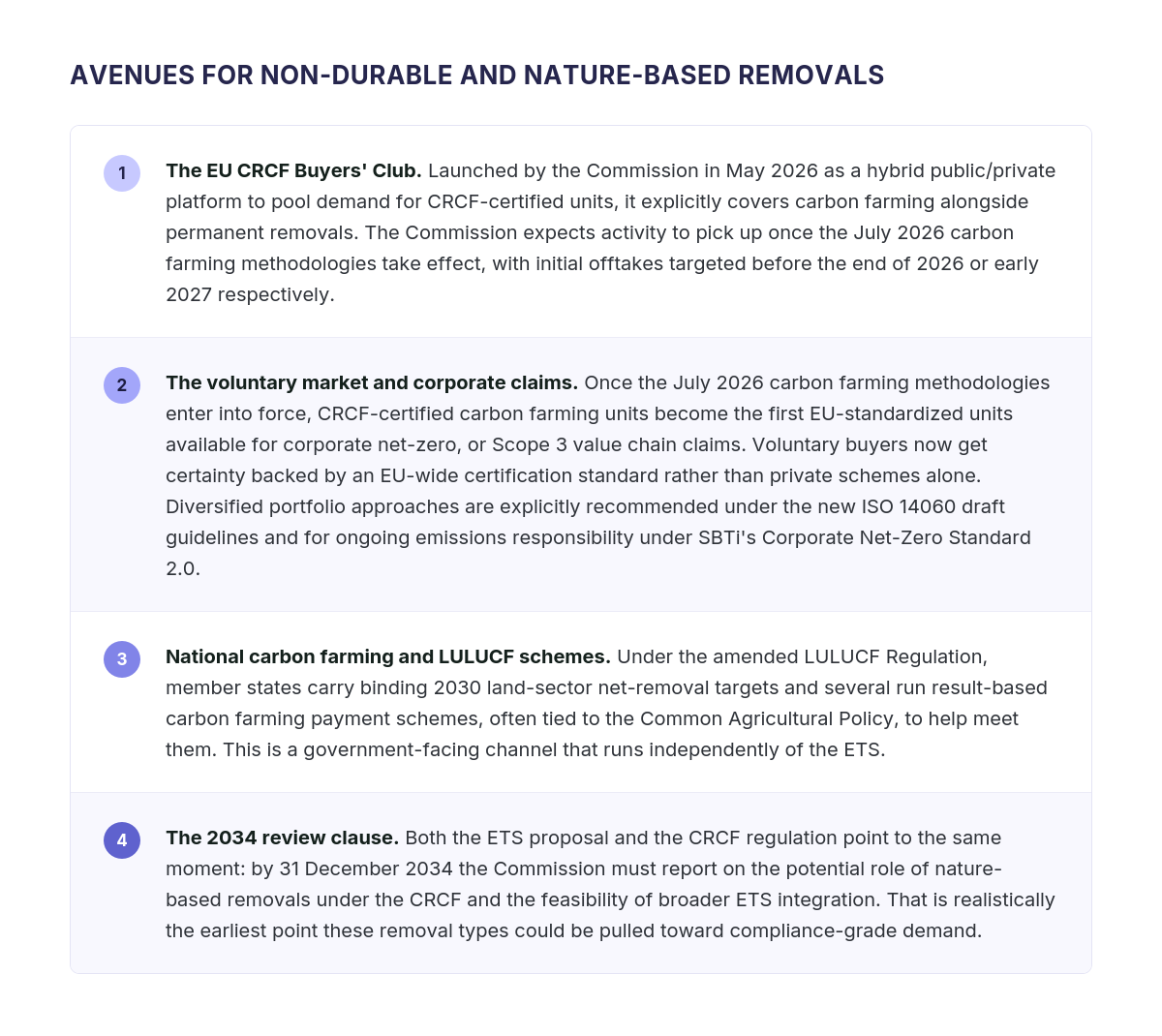
Hence, the voluntary market, the Buyers’ Club and national carbon farming support will likely be the near-term home for these removals, and the 2034 revision as the date to watch.
Further reading from CEEZER: CEEZER’s Claiming guide, SBTi Corporate Net-Zero Standard 2.0 update, ISO 14060 draft guidelines.
What it means for buyers
For almost all corporate buyers, buying removals remains a voluntary decision — the scheme doesn't provide a direct way to use removal credits directly for compliance other than for buyers who are also ETS-covered operators retiring their own captured emissions under article 14(1a). What changes is the backdrop: a public, well-funded, long-duration buyer is entering the removals market for the first time, and that reshapes credibility, pricing, and timing.

How CEEZER helps buyers navigate the landscape
Navigating a market where voluntary decisions and compliance rules are merging requires a thorough, holistic approach to carbon strategy. CEEZER brings clarity to this shifting landscape by mapping carbon removal projects directly against evolving EU CRCF methodologies, giving buyers immediate visibility into which supply will qualify as compliance-grade.
Through data-driven scarcity modeling and automated milestone tracking, CEEZER enables corporate procurement teams to structure multi-year offtake portfolios by balancing high-durability BioCCS and DACCS to hedge against post-2030 supply squeezes with cost-effective biochar and carbon farming for immediate Scope 3 impact. By translating complex EU policy into actionable procurement data, CEEZER ensures that buyers’ carbon strategies remain audit-proof, budget-optimized, and resilient to regulatory change.
The caveat that matters
None of this is law yet. The proposal now goes through negotiation between the European Parliament and the EU Council, with a political agreement targeted for early 2027 — and the detailed rules (who can bid, how tenders are run, how payments work) are left to delegated acts that have not been written.
CEEZER is tracking this proposal as it moves through Brussels. If you'd like a read tailored to your specific portfolio or supply pipeline, reach out to your CEEZER contact.







.png)