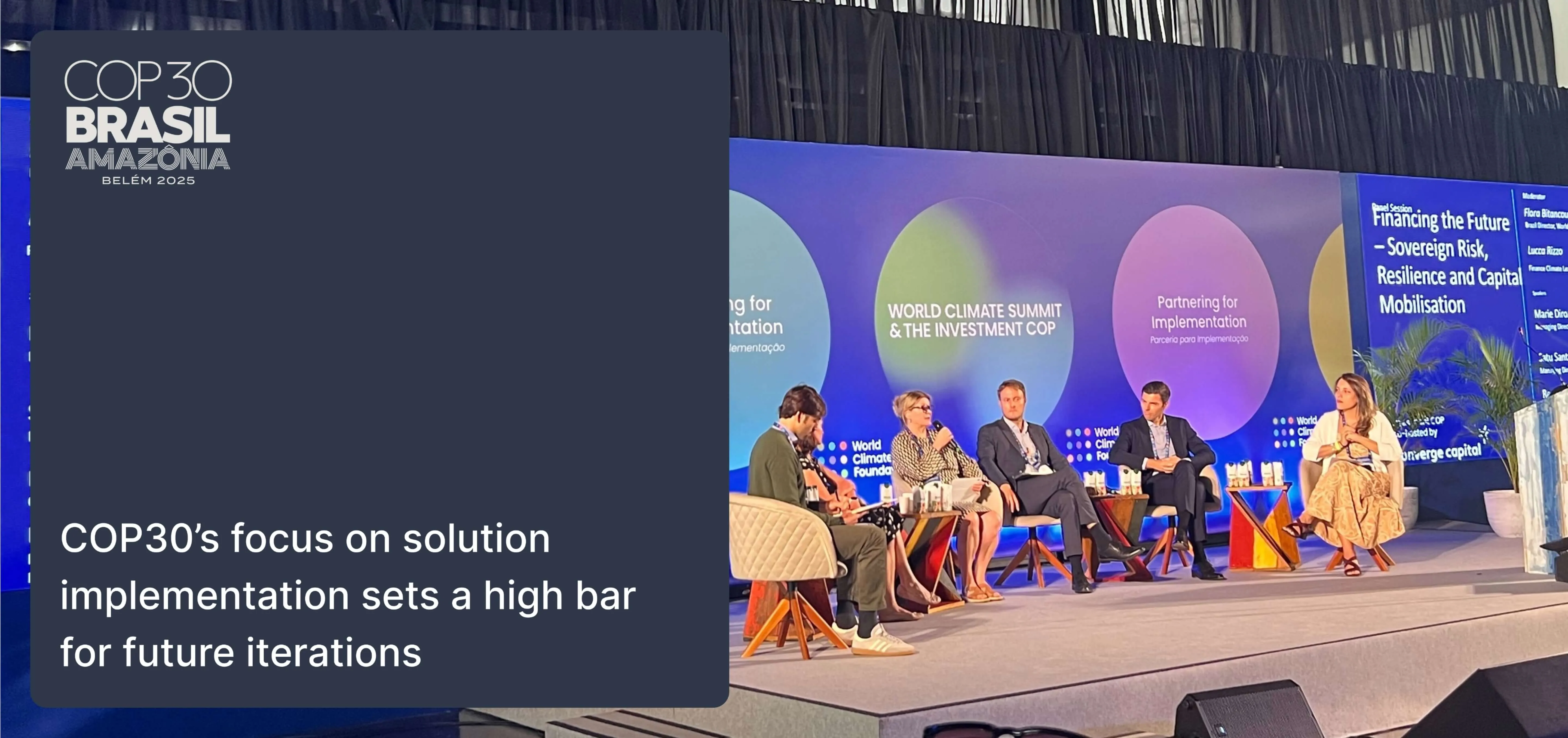

COP30’s central focus was ‘Implementation and Cooperation,’ recognizing the urgent need to act now in order to avoid severe climate change consequences. These risks include reaching critical ecosystem tipping points, impacting COP30’s host, Brazil and many other regions. Ultimately, the fight against climate change is safeguarding global ecosystems by supporting and re-establishing environmental balance.
With CEEZER’s objective at COP30 to go beyond external commentary and actively shape discussions around best practices for deploying effective corporate climate solutions, CEEZER’s Risk Manager, Vishnu Sunil and Chief Impact Officer, Dr. Carla Woydt, packed their bags and went to Belem.
.jpg)
Nature and Communities
The location of COP30 was symbolic, being the first COP held in the Amazon. In this context, nature-based removal solutions, nature protection, and the inclusion of Indigenous Peoples were central to the discussions on- and off-stage. Climate action is more than just nature and carbon; it must uplift the lives of people. COP30’s thematic axis on “Fostering Human and Social Development” advanced priorities such as climate education, job creation, health resilience, social protection, and gender and racial equity.
Against this backdrop, the Tropical Forests Forever Facility (TFFF) was launched as a pioneering mechanism designed to provide long-term, results-based payments to tropical forest nations. It is a major, innovative, blended finance mechanism which creates a permanent, large-scale source of funding to reward countries for protecting and expanding their tropical forests. It represents a paradigm shift from traditional climate aid, aiming to make forest conservation a viable and reliable economic model that competes with the income generated by deforestation. With a permanent capital base established for forest protection, the TFFF secured over USD 6.7 billion in its initial phase, backed by the endorsements from 63 countries.
This sends a signal to market participants to not wait until perfect political guardrails are effective but to move forward while political landscapes keep evolving. Corporates play an increasingly important role in demonstrating high-integrity engagement with the carbon markets, including conserving and reforesting global forests. CEEZER offers more than 25M tons of nature protection and restoration credits with proven social benefits to supporting a reversal of degrading forests, loss of ecosystem resilience, and the protection of life in global forests. CEEZER ensures that these nature-based forest projects improve the livelihoods of the local communities, indigenous people, and ground-based stakeholders through our robust, holistic risk assessment.
Market
COP30 provided a space to showcase some of the carbon market’s best projects. On stage of the first-of-its-kind CDR-centered pavilion, hosted by the COP30 initiative, leading projects, like Mombak, Mati, terradot or InPlanet showcased the carbon market’s climate impact through their combined potential to remove millions of tonnes of CO₂.
For most removal projects, which need high upfront capital, long-term agreements, and guaranteed long-term returns are vital to scale and become financially viable. As part of the CDR30 initiative, CEEZER hosted a webinar together with Isometric, IETA, and Varaha on How to Structure Risk Mitigated CDR Long-Term Portfolios Accommodating Large Enterprise Timescales and Delivery Schedules. As many buyers approach their net-zero target years and demand-driven supply shortages are becoming visible, long-term offtake agreements become an important tool to secure high-quality removal credits. Buyers benefit by locking-in favourable prices (up to a 30 percent discount based on CEEZER data) and secure preferred volumes towards their net-zero targets, plus take responsibility for ongoing emissions.
CEEZER’s recent webinar Long-term offtakes: A buyer's guide journey to smarter, more strategic carbon procurement showcases how N26 approaches long-term engagement with the voluntary carbon market together with CEEZER.
Market announcements worth highlighting:
- Open Coalition on Carbon Markets: Brazil launched its Open Coalition on Carbon Markets. This initiative aims to establish a shared standard across different carbon credit trading systems to enhance transparency and accelerate engagement with the carbon markets, including Brazil, Andorra, Guinea, New Zealand, Monaco, Singapore, China, the European Union, the United Kingdom, Canada, Chile, Germany, Mexico, Armenia, Zambia, France, Rwanda and Norway. It aims at limiting further fragmentation of the market and strengthening cooperation.
- Coalition to Grow Carbon Markets, initiated by Singapore, the UK and Kenya was launched at COP30 Business and Finance Forum with the goal of attracting high-integrity demand from corporate actors. Governments including Canada, France, Kenya, Luxembourg, New Zealand, Panama, Peru, Singapore, Switzerland, the UK, and Zambia committed to endorse its Shared Principles for Growing High-Integrity Use of Carbon Credits. Followed by Germany, Indonesia, the Netherlands and South Africa who also expressed support for the initiative.
As governments and corporate buyers continue emphasizing quality over quantity in their carbon credit investments, CEEZER remains the leading partner to help buyers understand project quality and risk, navigate the carbon market, and build tailored, multi-asset portfolios based on companies’ specific budget and climate goals.Through high-quality carbon projects, buyers go beyond decarbonization, supporting important co-benefits related to biodiversity and ecosystem benefits, education, employment and poverty alleviation, green energy, and many more.

Article 6
Article 6.2 of the Paris Agreement establishes a framework for voluntary cooperation between countries to achieve their climate targets, known as Nationally Determined Contributions (NDCs). Negotiations during COP30 clearly signaled for countries to advance cooperation with and implementation of high-integrity carbon market infrastructure.
CEEZER’s Dr. Carla Woydt spoke in a session at the IETA and ICC pavilion centered on carbon market readiness of different countries (find post here).
Conclusion: Host countries are at very different stages in carbon market readiness, ranging from political readiness over institutional readiness to the development of a clear carbon market framework and full implementation of ITMO transactions. The discussion identified a clear need for centralized and standardized capacity-building for countries with orchestrated expert support.
Initiatives announced during COP30 closely related to the conclusion of CEEZER’s Article 6 panel:
- Article 6.2 Ambition Dialogue: A two-day dialogue was held to accelerate implementation, providing a platform for countries to share insights, experiences, challenges, and lessons learned on operationalizing Article 6.2 cooperative approaches.
- Release of Crediting Protocol: Singapore, Verra, and Gold Standard released an Article 6.2 crediting protocol, focusing on existing, independent standards for the trading of Internationally Transferred Mitigation Outcomes (ITMOs).
- The first bilateral agreement focused on CDR signed earlier in 2025 between Norway and Switzerland was highlighted at COP30 as a blueprint for cross-border transfers of durable CDR (specifically for geological carbon storage in Norway). This was confirmed as the first international transaction of its kind under Article 6.2.
In short, while there were no major changes to the negotiated rules (which were largely settled at COP29), COP30 served as a critical forum for discussing the practical roll-out of Article 6.2 and the launch of protocols aimed at guiding high-integrity carbon credit trading.
In this spirit, the COPs to come will offer a stage for more structured feedback and lessons learned for individual bilateral agreements, and will provide stricter guidance on handling discrepancies between the official guidelines and actual practice. This transition from theoretical rule-making toward implementation feedback is worth mentioning as it clearly signals the intention to keep course for large-scale implementation across host countries.
Article 6.4 of the Paris Agreement establishes a centralized carbon crediting mechanism, called the Paris Agreement Crediting Mechanism (PACM, overseen by a UN body, the Supervisory Body).
Discussions around the general governance model prevailed, however some clear decisions have been made:
- Term limits for the Supervisory Board will not be removed, members are expected to act with “independence, impartiality and integrity”
- Members are now requested to engage with Indigenous Peoples and local communities
- The Article 6.4 sections on standards and methodologies remain unfinalized, and debates around the next steps around permanence and key issues like reversal risk will happen at the Supervisory Board in 2026.
The end of the CDM: A major step in the transition from the Kyoto Protocol's carbon market (the CDM) has been made, providing a clear shift to the Paris Agreement carbon market (under Article 6.4). Remaining CDM funds will be transferred to the PACM, totalling $26.8, with an additional funding to accelerate capacity-building could increase by up to $5 million.
- The transfer signals the definitive end of the operational era of the CDM, allowing the institutional and financial resources to be repurposed for its successor mechanism.
- The transfer of all remaining CDM funds is much needed to establish PACM operations, including the Supervisory Body, the secretariat's work, and the development of high-integrity methodologies and standards.
- The capacity-building component is crucial, as the new Article 6.4 mechanism has stricter rules, particularly around corresponding adjustments (to avoid double counting) and demonstration of additionality. This support helps developing countries overcome the technical hurdles of engaging in the new carbon market.
On top, there was a minor update on timelines: Countries have additional 6 months to submit approvals for transitioning eligible CDM projects into the Article 6.4 mechanism and CDM credit transfers until 31 December 2026. Despite these developments, it is worth mentioning, however, that Article 6.4 is still very far from being operational.
.webp)
What does that mean for stakeholders
Buyers
- Reiterating the central message: high-quality carbon market participation is an effective tool for buyers to reach climate targets, initiatives such as the Coalition to Grow Carbon Markets aim to further encourage engagement and build trust for corporate buyers.
- More buyers are openly discussing their engagement with the carbon markets highlighting the need for transparency and clear guidance for long-term engagement.
- There is a clear momentum for nature-based solutions: as frameworks are becoming more rigorous, refined methodologies becoming operational, and digital MRV as a standard tool for certification and monitoring, nature-based solutions regain credibility as a project type with many benefits beyond carbon.
Suppliers
- Using high-integrity carbon crediting standards and methodologies recognized by independent integrity frameworks such as the IC-VCM increases buyer trust and confidence.
- Data and transparency are key for corporate buyers to engage.
- Providing information about financial backing and realistic and reliable delivery timelines are a central component for buyers who plan long-term offtakes to achieve net-zero targets.
Conclusion
Despite the infrastructure challenges and the literal fire that tore through the event, Brazil’s COP30 stood out in many ways. It reinforced the importance of face-to-face discussions, fostering cooperation and sending participants home with a bigger and better connected network, stronger relationships, and a clear vision forward.
Is it enough? Of course not. It is absolutely vital to translate discussion into concrete actions and to hold the promise of implementation. We have to keep pushing at the policy level, innovate at the project level, and make it as easy and secure as possible for buyers to invest in carbon projects. CEEZER will continue to push on all of these fronts, and remains a key partner in climate finance for those looking towards a net-zero transition supporting all people and the planet.







.png)